Personal loan EMI calculator
Personal loans are the easiest money to borrow and among the most expensive. There is no asset behind them, so the rate carries all of the lender's risk — typically somewhere between 11% and 24%.
Work out the EMI below, and look at the interest figure before the monthly one.
- Amount borrowed₹3,00,000
- Total interest₹69,118
- Total repaid₹3,69,118
Balance over time
What you still owe at the end of each year.
Year of the loan →
Year-by-year schedule3 years
| Year | EMIs paid | Towards the loan | Interest | Balance left |
|---|---|---|---|---|
| 1 | 12 | ₹86,447 | ₹36,592 | ₹2,13,553 |
| 2 | 12 | ₹99,357 | ₹23,682 | ₹1,14,196 |
| 3 | 12 | ₹1,14,196 | ₹8,844 | ₹0 |
Free, no sign-up. The calculation runs on your device — nothing you type is sent anywhere.
What it costs
₹3,00,000 at 14% over 3 years is an EMI of ₹10,253 and ₹69,118 of interest — roughly 23% on top of what you borrowed, for three years of money. At 20% the same loan costs over ₹1 lakh in interest.
That is not a reason never to take one. It is a reason to be specific about what it is for, because the arithmetic punishes vague borrowing much harder than a secured loan does.
When a personal loan is the cheap option
It sounds contradictory, but there are cases where 14% is the sensible choice:
- Clearing credit card debt. Revolving card balances are commonly charged at 30–45% a year. Moving that to a 14% personal loan with a fixed end date is a large saving, provided the cards then stay unused.
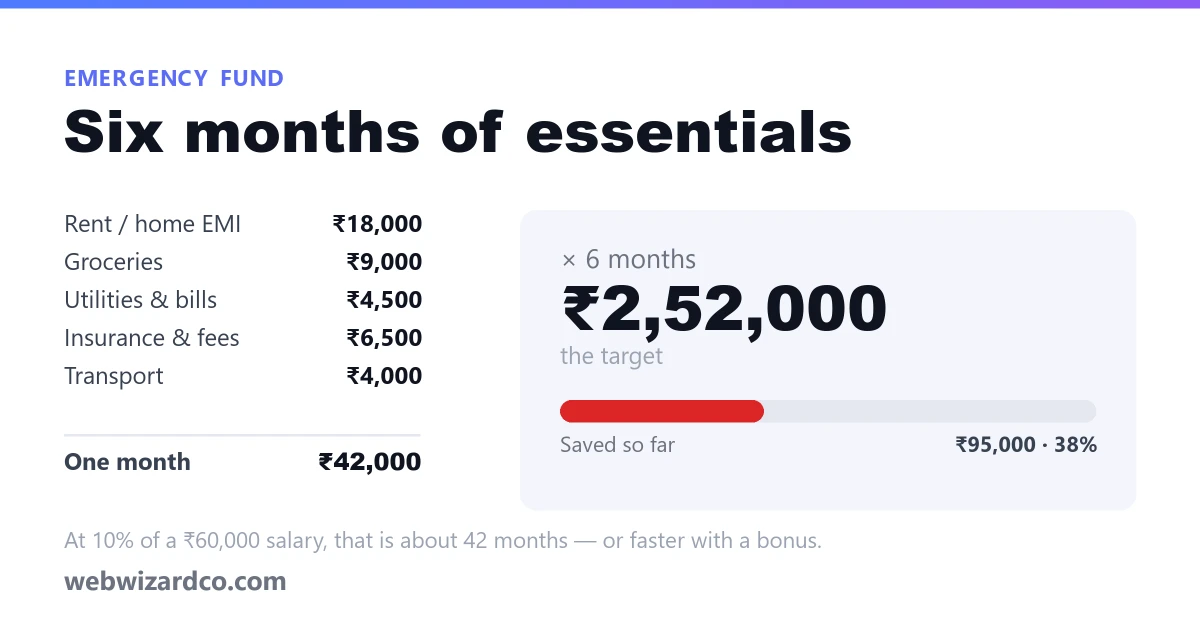
- A genuine emergency with no fund behind it. Expensive money beats no money. It is also the clearest possible argument for building an emergency fund afterwards.
- A deadline you cannot move — a medical bill, a deposit, a fee — where the alternative costs more than the interest.
What it is rarely right for: a holiday, a wedding upgrade, a phone, or investing. Borrowing at 14% to invest in something you hope returns 12% is a guaranteed loss dressed up as a strategy.
Check the rate you were actually quoted
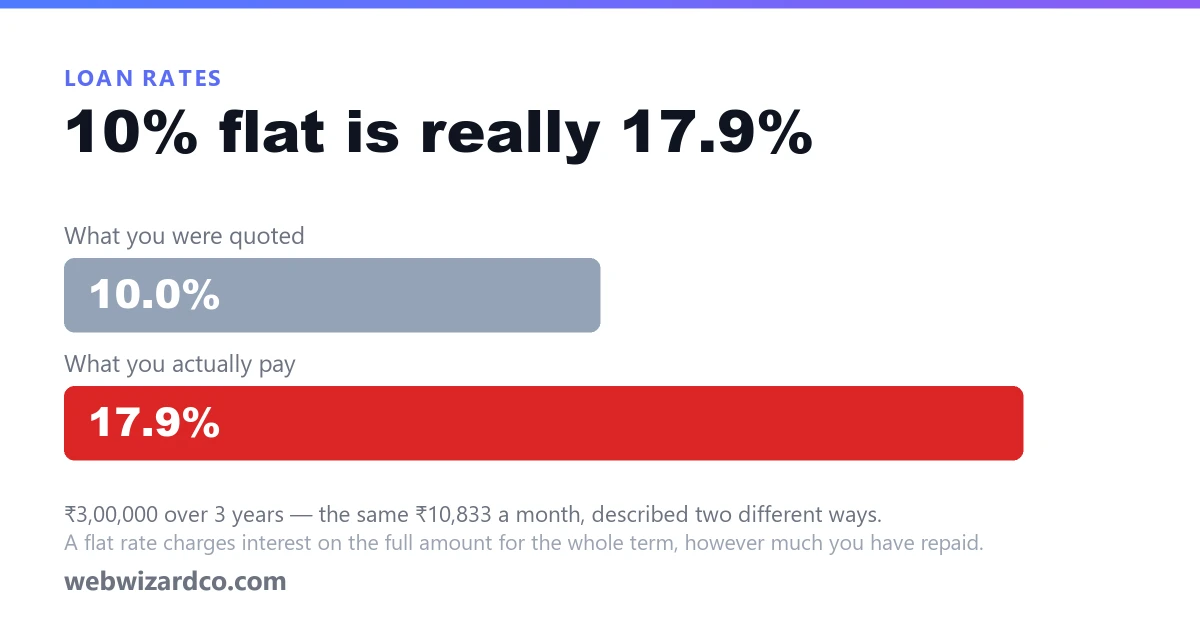
A flat rate charges interest on the original amount for the entire term. A 10% flat rate on ₹3,00,000 over 3 years means ₹90,000 of interest and an EMI of ₹10,833 — equivalent to about 17.9% on a reducing balance. If a quote seems far better than everyone else's, this is usually why. Put the EMI you were quoted into this calculator and adjust the rate until it matches; that is the real rate.
Also look past the rate at the processing fee, typically 1–3% of the amount, deducted before the money reaches you, and at any prepayment or foreclosure charge, which personal loans usually do have.
Before you take one
A personal loan EMI does not have a bucket of its own — it competes with whatever it was borrowed to fix. If several EMIs are already running, add them together and compare the total with your take-home pay; once all EMIs combined pass about a third of income, an unexpected month becomes very difficult to absorb.
Enter your salary above to see this EMI as a percentage of it, and consider setting up a budget before borrowing rather than after.
Other calculators
Worth reading first
How to use this calculator
Three inputs, and one optional field that most calculators leave out.
Enter the amount, rate and tenure
Type them in or drag the sliders. The EMI and the total interest update as you go.
Add an extra monthly amount
Optional, and the most useful box on the page: it shows how many years a small regular overpayment removes, and what that saves in interest.
Check it against your income
Enter your monthly take-home pay to see the EMI as a share of it, then look at the year-by-year schedule to see how slowly the balance moves at the start.