Home loan EMI calculator
A home loan is the largest number most people ever agree to, and the EMI is the least interesting part of it. What matters is the total — and how much of that total you can remove by paying a little more each month.
Set the amount, rate and tenure below. Then add an extra monthly amount and watch the years disappear.
- Amount borrowed₹50,00,000
- Total interest₹54,13,879
- Total repaid₹1,04,13,879
A home EMI comes out of the Household share of your income — 35% on the 25-10-15-15-35 budget, which also has to cover everything else that share pays for.
Balance over time
What you still owe at the end of each year.
Year of the loan →
Year-by-year schedule20 years
| Year | EMIs paid | Towards the loan | Interest | Balance left |
|---|---|---|---|---|
| 1 | 12 | ₹99,511 | ₹4,21,182 | ₹49,00,489 |
| 2 | 12 | ₹1,08,307 | ₹4,12,387 | ₹47,92,181 |
| 3 | 12 | ₹1,17,881 | ₹4,02,813 | ₹46,74,300 |
| 4 | 12 | ₹1,28,300 | ₹3,92,394 | ₹45,46,000 |
| 5 | 12 | ₹1,39,641 | ₹3,81,053 | ₹44,06,359 |
| 6 | 12 | ₹1,51,984 | ₹3,68,710 | ₹42,54,375 |
| 7 | 12 | ₹1,65,418 | ₹3,55,276 | ₹40,88,957 |
| 8 | 12 | ₹1,80,039 | ₹3,40,655 | ₹39,08,918 |
| 9 | 12 | ₹1,95,953 | ₹3,24,741 | ₹37,12,965 |
| 10 | 12 | ₹2,13,274 | ₹3,07,420 | ₹34,99,691 |
| 11 | 12 | ₹2,32,125 | ₹2,88,569 | ₹32,67,566 |
| 12 | 12 | ₹2,52,643 | ₹2,68,051 | ₹30,14,923 |
| 13 | 12 | ₹2,74,974 | ₹2,45,720 | ₹27,39,949 |
| 14 | 12 | ₹2,99,279 | ₹2,21,415 | ₹24,40,670 |
| 15 | 12 | ₹3,25,733 | ₹1,94,961 | ₹21,14,937 |
| 16 | 12 | ₹3,54,525 | ₹1,66,169 | ₹17,60,412 |
| 17 | 12 | ₹3,85,862 | ₹1,34,832 | ₹13,74,550 |
| 18 | 12 | ₹4,19,968 | ₹1,00,726 | ₹9,54,582 |
| 19 | 12 | ₹4,57,090 | ₹63,604 | ₹4,97,492 |
| 20 | 12 | ₹4,97,492 | ₹23,202 | ₹0 |
Free, no sign-up. The calculation runs on your device — nothing you type is sent anywhere.
What a home loan really costs
₹50,00,000 at 8.5% over 20 years is an EMI of ₹43,391. Over those 240 months you repay ₹1,04,13,879 — the ₹50 lakh you borrowed, plus ₹54,13,879 of interest. You pay for the house roughly twice.
That figure, not the EMI, is the one to keep in mind, because every decision about the loan moves it by lakhs.
20 years or 30?
The same ₹50,00,000 at 8.5% over 30 years has an EMI of ₹38,446 — ₹4,945 a month easier. The interest over the full term becomes ₹88,40,443. Ten extra years of borrowing costs about ₹34 lakh more, in exchange for saving just under ₹5,000 a month.
Sometimes that is the right trade: a longer tenure at the start of a career, when income is likely to rise, keeps the monthly figure survivable. But it should be a decision, not a default, and it is worth revisiting every time your salary changes. A longer tenure taken deliberately and then shortened by prepaying is a much better position than a 30-year loan left to run.
What a small prepayment does
This is the number that surprises people. Take the same ₹50,00,000 at 8.5% over 20 years and add just ₹5,000 a month — about 11% more than the EMI:
- The loan finishes in 15 years and 7 months instead of 20 — 53 months early.
- Interest falls from ₹54,13,879 to ₹40,24,629.
- You save ₹13,89,250, for a total outlay of about ₹9.35 lakh in extra payments.
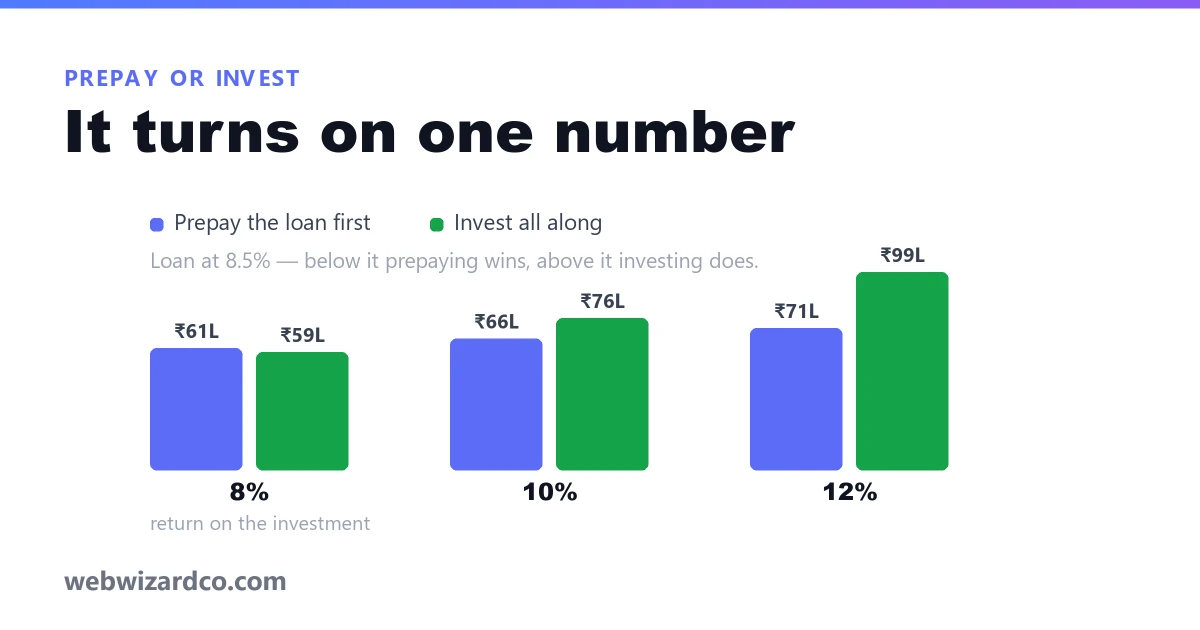
Every extra rupee goes straight against the balance, so it stops accruing interest for the whole remaining life of the loan. The earlier in the loan you do it, the more it is worth — which is the opposite of how most people plan, leaving prepayment for later when there is more spare income.
For floating-rate home loans to individuals, the RBI does not allow foreclosure or prepayment charges, so this costs nothing beyond the money itself. Fixed-rate loans can carry a penalty; check your sanction letter.
Floating or fixed
Most Indian home loans are floating and linked to an external benchmark, usually the RBI repo rate, plus a spread set by the lender. When the benchmark moves, lenders typically hold the EMI steady and change the tenure instead — which means a rate rise can quietly add years to your loan without the monthly figure moving at all. It is worth asking for the revised tenure each time rates change, and recalculating here.
Before you commit
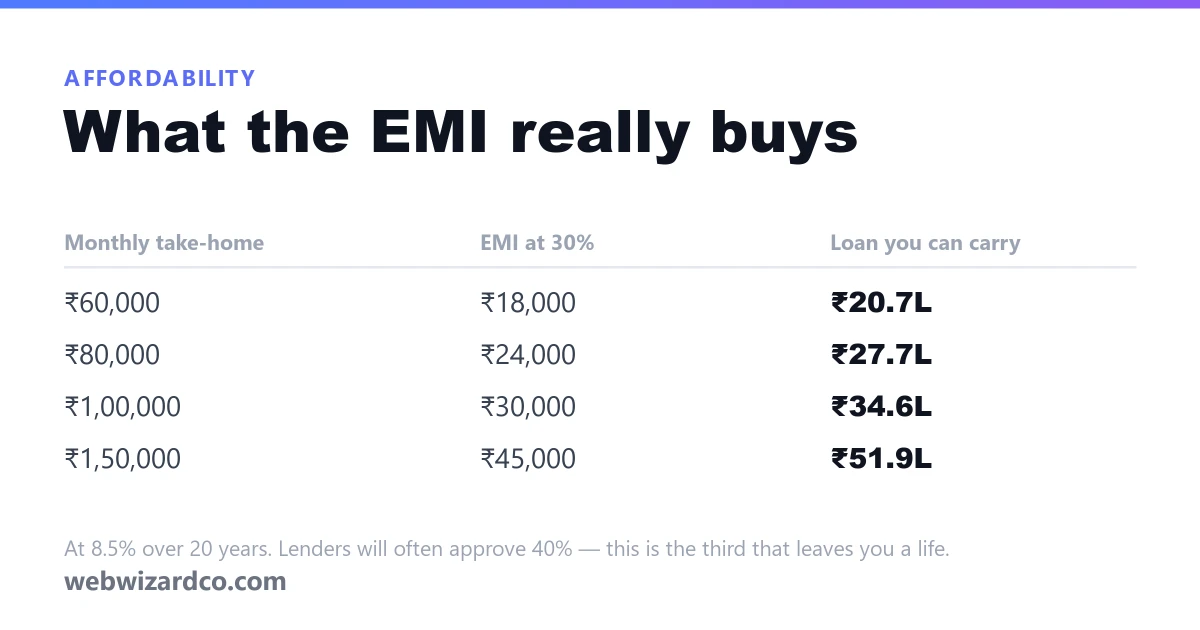
A home EMI comes out of the household share of your income. On the 25-10-15-15-35 split that is 35% of take-home pay, and it has to cover rent or EMI plus groceries, utilities, school fees and everything else the house needs. An EMI at 35% of salary on its own leaves nothing for the rest of the bucket.
Add your take-home pay above and the calculator will show where the EMI lands. Then track a month or two of real spending before signing — the gap between what people think their household costs and what it actually costs is usually where the trouble starts.
Other calculators
Worth reading first
How to use this calculator
Three inputs, and one optional field that most calculators leave out.
Enter the amount, rate and tenure
Type them in or drag the sliders. The EMI and the total interest update as you go.
Add an extra monthly amount
Optional, and the most useful box on the page: it shows how many years a small regular overpayment removes, and what that saves in interest.
Check it against your income
Enter your monthly take-home pay to see the EMI as a share of it, then look at the year-by-year schedule to see how slowly the balance moves at the start.