EMI calculator
Enter the amount, the interest rate and how long you want to take, and you will see the monthly EMI, how much of the total is interest rather than the loan itself, and the balance falling month by month.
The part most calculators leave out is underneath: put in an extra amount per month and you will see how many years it removes from the loan. On most loans that number is larger than people expect.
- Amount borrowed₹10,00,000
- Total interest₹2,45,501
- Total repaid₹12,45,501
Balance over time
What you still owe at the end of each year.
Year of the loan →
Year-by-year schedule5 years
| Year | EMIs paid | Towards the loan | Interest | Balance left |
|---|---|---|---|---|
| 1 | 12 | ₹1,65,830 | ₹83,270 | ₹8,34,170 |
| 2 | 12 | ₹1,81,386 | ₹67,714 | ₹6,52,784 |
| 3 | 12 | ₹1,98,401 | ₹50,699 | ₹4,54,383 |
| 4 | 12 | ₹2,17,013 | ₹32,088 | ₹2,37,370 |
| 5 | 12 | ₹2,37,370 | ₹11,730 | ₹0 |
Free, no sign-up. The calculation runs on your device — nothing you type is sent anywhere.
How an EMI is worked out
Every EMI on a reducing-balance loan comes from one formula:
EMI = P × r × (1 + r)n ÷ [ (1 + r)n − 1 ]
where P is the amount borrowed, n is the number of monthly instalments, and r is the monthly interest rate — the annual rate divided by twelve and by a hundred. A 9% loan has a monthly rate of 0.75%.
The EMI stays the same every month, but what it is made of does not. In the first month almost all of it is interest and very little touches the balance. By the last year that has reversed. This is why paying a loan off five years early saves far more than five years' worth of EMIs — the years you remove are the cheap ones at the end, so what you actually avoid is the expensive interest at the start compounding on a balance that was never there.
A worked example
₹10,00,000 at 9% for 5 years gives an EMI of ₹20,758. Over the full term you repay ₹12,45,501, of which ₹2,45,501 is interest — about a quarter as much again as you borrowed. Stretch the same loan to 7 years and the EMI drops, but the interest paid climbs sharply. That is the trade every tenure decision comes down to: a payment you can afford this month against a total you pay once.
What the monthly figure has to fit into
An EMI is only sensible relative to what you earn. Most lenders will approve total EMIs up to roughly 40–50% of take-home pay, which is a limit built around their risk, not your life — at that level there is very little left for saving, and none for anything going wrong.
A more useful test is the one the 25-10-15-15-35 budget applies: a home EMI comes out of the 35% household share, a car EMI out of the 15% for travel and vehicles. If the EMI eats the whole bucket, the loan is not affordable, whatever the lender says. Enter your monthly take-home above and the calculator will show the EMI as a percentage of it.
Flat rate and reducing balance are not the same number
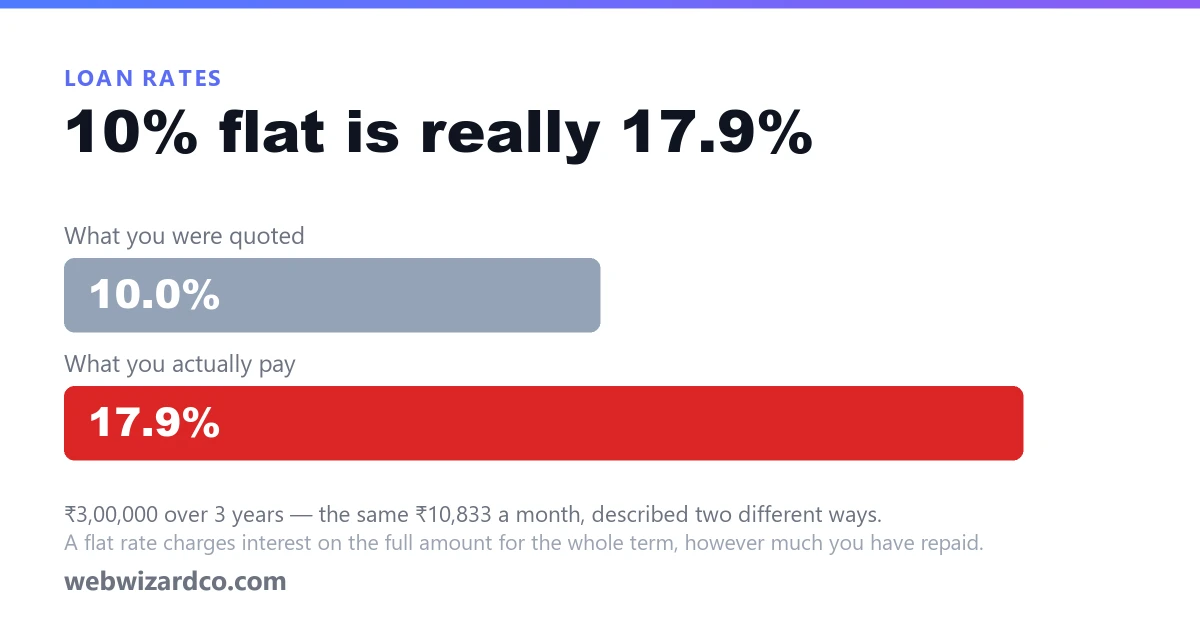
Some lenders, particularly for two-wheelers, consumer durables and small personal loans, quote a flat rate: interest charged on the original amount for the whole term, regardless of how much you have already repaid. It sounds cheaper and never is.
A 10% flat rate on ₹3,00,000 over 3 years means ₹90,000 of interest and an EMI of ₹10,833. The same repayment on a reducing-balance basis corresponds to an interest rate of about 17.9% — near enough double the number you were quoted. This calculator, like every bank EMI, works on reducing balance. If someone quotes you a flat rate, put their EMI in here and solve backwards to see what you are really being charged.
Other calculators
Worth reading first
How to use this calculator
Three inputs, and one optional field that most calculators leave out.
Enter the amount, rate and tenure
Type them in or drag the sliders. The EMI and the total interest update as you go.
Add an extra monthly amount
Optional, and the most useful box on the page: it shows how many years a small regular overpayment removes, and what that saves in interest.
Check it against your income
Enter your monthly take-home pay to see the EMI as a share of it, then look at the year-by-year schedule to see how slowly the balance moves at the start.