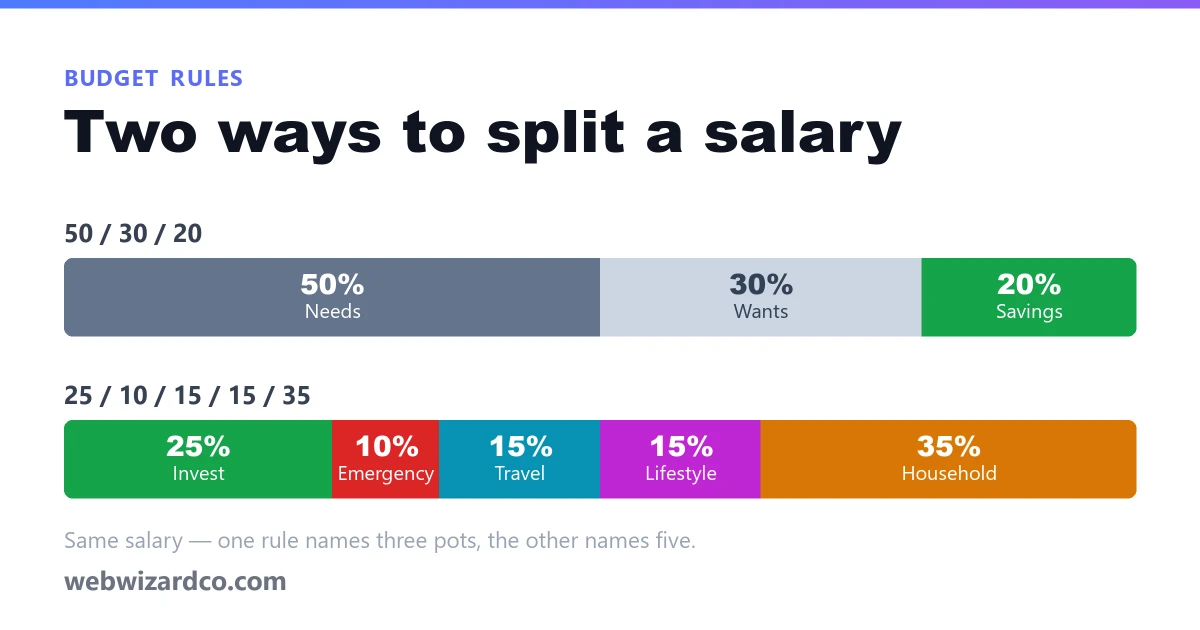
Every budgeting rule is the same idea wearing different numbers: decide where the money goes before it goes somewhere. The two you will meet most often are 50/30/20 and the 25-10-15-15-35 split. They are not rivals so much as different levels of detail — and the right one is mostly a question of which you will actually keep using.
What each rule says
50/30/20, popularised in the United States, divides take-home pay three ways: 50% to needs (rent, groceries, utilities, transport, insurance, minimum loan payments), 30% to wants (eating out, shopping, entertainment, subscriptions) and 20% to savings and debt repayment.
25-10-15-15-35 names five: 25% investments, 10% emergency fund, 15% travel and car, 15% lifestyle and personal, 35% household. It splits "savings" into money for the future and money for disasters, and pulls vehicle costs out of the general pile, because in most Indian households they are large, fixed and easy to underestimate.
The same salary, both ways
On a ₹60,000 take-home:
| 50 / 30 / 20 | 25 / 10 / 15 / 15 / 35 | ||
|---|---|---|---|
| Needs | ₹30,000 | Household | ₹21,000 |
| Wants | ₹18,000 | Travel & car | ₹9,000 |
| Savings | ₹12,000 | Lifestyle & personal | ₹9,000 |
| Investments | ₹15,000 | ||
| Emergency fund | ₹6,000 |
Line them up and the difference is clear. Both send 50% to keeping the household running (₹30,000 against ₹21,000 + ₹9,000). Both leave 30% for discretionary spending — except the five-way split has already decided that half of it is for the car and travel. And the "20% savings" becomes 35%, because the five-way rule treats investing as a first claim rather than a leftover.
That last part is the real argument. 20% of ₹60,000 is ₹12,000; 25% plus 10% is ₹21,000. Over ten years, at the kind of return a long-term equity SIP has historically produced, that gap is not a rounding error — it is a different retirement.
Where 50/30/20 struggles here
Rent breaks the 50. In Mumbai, Bengaluru or Gurgaon, a family flat can take 35–45% of take-home on its own. Add groceries, utilities, school fees and insurance and "needs" is at 65% before anything unusual happens. A rule whose first number is already impossible tends to get abandoned in week one.
Saving and investing are not the same thing. One 20% line lets you put everything in a savings account, feel disciplined, and lose to inflation for a decade. Splitting it forces the question: how much is for emergencies, and how much is compounding?
Vehicles hide inside "needs". Fuel, EMI, insurance, servicing, parking and tolls easily reach ₹8,000–₹12,000 a month. Buried in a ₹30,000 needs bucket they are invisible; on their own line, they are a decision.
Irregular money has nowhere to go. Festival spending, a wedding, the annual insurance premium, a family medical bill — none of these are monthly, and none fit neatly into needs or wants.
Where 50/30/20 is better
Do not dismiss it. Three numbers are easy to remember, easy to decide against at the counter, and hard to get wrong. If you are 23, living with parents or sharing a flat, with no dependants and no EMIs, the extra structure of a five-way split buys you very little — and a rule you follow beats a better rule you do not.
The same goes for anyone who has tried and abandoned a detailed budget before. Start at three pots. Split them later, when the simple version has become a habit.
What actually matters in both
The percentages are the least important part of either rule. What both get right is the order: money for the future is moved out on payday, before spending gets a chance to expand into it. Saving what is left at the end of the month reliably produces nothing, because spending grows to fill whatever is in the account.
So whichever split you pick, set the investment transfer for a day or two after salary day and let it run before anything else can compete for it.
Adapting the numbers to your life
Neither rule is a law. Take the five-way split and move it around:
- High rent: household 45%, lifestyle 10%, travel 10%, investments 25%, emergency 10%. Protect the investment line; shrink the discretionary ones.
- No vehicle: travel 5%, and push the other 10% into investments or household.
- Home loan running: the EMI sits in household, which often pushes it past 50% — so hold investments at 20% for a while rather than dropping them to nothing.
- Emergency fund complete: the 10% moves to investments permanently. That is the point of finishing it.
- Freelance or variable income: apply the percentages to whatever actually arrived that month, and keep a larger emergency fund than a salaried person would.
The only real constraint is that the numbers add up to 100 and that the future gets paid first.
Running either one in practice
A rule only does something once you can see spending against it. The salary budget tracker defaults to 25-10-15-15-35, but the percentages are editable — set them to 50/30/20 across three buckets and leave the rest at zero if that is the rule you want, or write your own five.
After that it is the same routine either way: log expenses as you spend, let recurring bills add themselves, and check once a week which bucket is running ahead. The rule decides the targets; the tracking tells you whether you hit them.
This is general budgeting guidance, not personalised financial advice. Debts, dependants and income stability may call for a different split.