Almost everyone has started an expense tracker. A spreadsheet on the 1st, three careful days, a gap over the weekend, and by the 10th it is a document you avoid opening. The failure is almost never laziness — it is that the method asked for more effort than the answer was worth.
Here is a version that survives the second week, because it is built around the two facts that kill tracking: you will not do data entry, and you will miss days.
Log at the moment of payment, not at night
The single biggest change: enter the expense while you are still standing at the counter, or in the three seconds after the UPI confirmation screen. Not that evening, and certainly not on Sunday for the whole week.
Evening logging means remembering seven things, and you will remember five. Sunday logging means remembering forty, and at that point you are reconstructing a statement rather than tracking spending — which is the moment most people quit. Payment time is the only time you have perfect information and zero effort of recall.
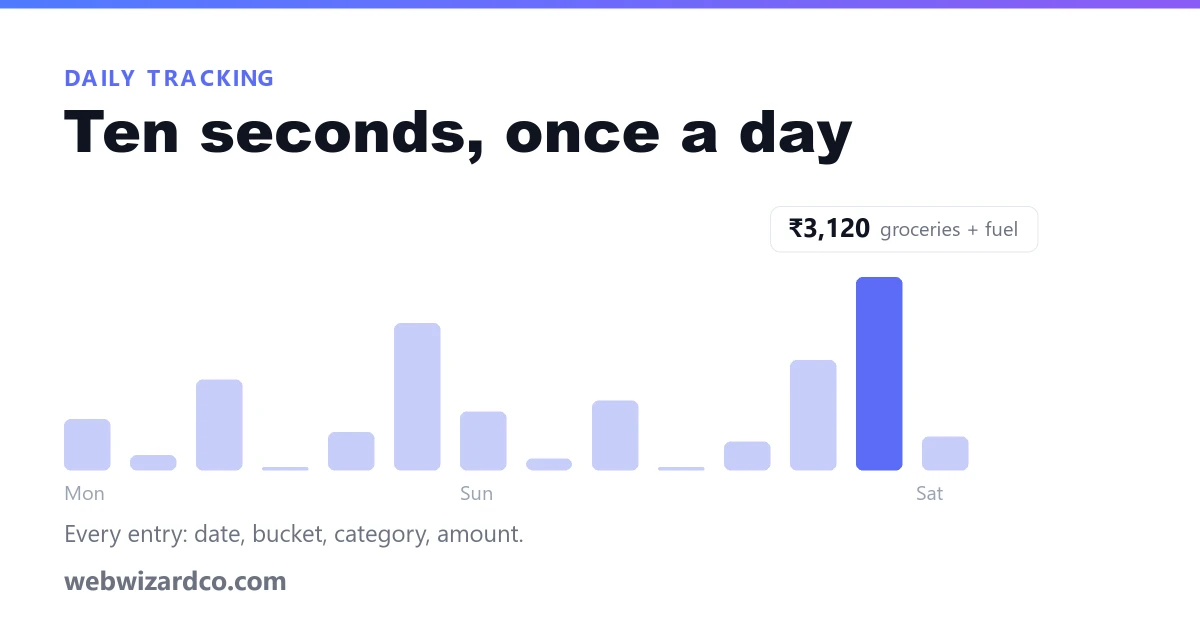
That only works if the entry itself is trivial. In the budget tracker an expense is five fields — date, bucket, category, amount and an optional note — with Today and Yesterday as one tap. It is designed to be finished before you have put your phone back in your pocket.
Automate everything that repeats
Look at last month's statement and mark the lines that will appear again this month at roughly the same amount: rent or home EMI, the SIP, car or phone EMIs, insurance premiums, school fees, broadband, the maid and cook, society maintenance, the streaming subscriptions.
For most salaried households that is somewhere between 60% and 75% of everything they spend. There is no value in typing it out every month, and every month you retype it is another chance to stop. Set each one up once as a recurring expense with the day of the month it goes out, and it is added automatically from then on.
What is left — groceries, fuel, eating out, a cab, a gift, a repair — is the part that actually varies, and the part worth your attention. That is usually three to six entries a day at most, and often none.
Use few categories, and keep them stable
A tracker with sixty categories feels thorough for a week and then becomes a decision every time you spend money. Was that "eating out" or "food delivery"? Is the chemist "medical" or "groceries"? Those small hesitations are what make an entry take thirty seconds instead of ten.
Pick the category that is obviously right and move on. If two feel equally correct, the distinction was never going to change a decision, so it does not matter which you pick — only that you pick the same one next time.
This is also an argument for grouping categories into a handful of larger buckets. You will never act on "₹380 on auto rickshaws". You will act on "travel is at 90% with nine days to go".
Compare against a budget, not against zero
A list of expenses tells you what happened. It does not tell you whether it was fine. "₹9,400 on groceries" only means something next to "₹21,000 is what household gets this month".
That is the real reason to split your salary before you spend it — with the 25-10-15-15-35 rule or your own percentages. Each bucket gets a number on payday, and every expense afterwards is measured against it. On the 14th you do not see a list; you see that lifestyle is two-thirds gone and there are sixteen days left, which is early enough to do something about it.
Without that comparison, tracking is bookkeeping. With it, tracking is a decision you can act on.
Two minutes a week, not an hour a month
Once a week — Sunday evening works for most people — open the tracker and look at three things:
- Which bucket is furthest ahead of schedule. Two weeks in, a bucket should be roughly half used.
- The biggest single expense of the week. Was it planned? Would you do it again?
- What is still due. Recurring bills that have not gone out yet are money already committed.
That is the whole review. It takes two minutes because the data is already there, and it is what turns a month of entries into a decision — eat in for the rest of the week, delay the purchase, move the trip.
When you miss days — and you will
You will travel, get ill, or simply forget for four days. The method has to survive that, so here is the rule: do not reconstruct the gap. Add the two or three amounts you genuinely remember, ignore the rest, and start again today.
An expense tracker with a four-day hole is still useful. A tracker you abandoned because catching up felt like homework is worth nothing. Approximate and current beats exact and dead, every time.
Cash, other accounts, other people
This is where automatic, bank-linked apps quietly fail. They see one account. They do not see the ₹500 you handed over in cash, the UPI you sent from a different bank, the groceries your partner paid for, or the card your company reimburses later.
Entering spending yourself takes a few seconds, but it covers all of it — which is why a self-entered tracker usually ends up closer to reality than one wired to a bank feed. If you and your partner run one household budget, agree on who logs what: usually whoever paid.
What one honest month gets you
At the end of a month of this you have something most people never have: a real number for what your life costs, split by where it went, plus the same figure for every month after it.
That number is the input to almost every other financial decision — how big your emergency fund needs to be, whether a ₹15,000 EMI is survivable, how much you can realistically invest each month. Without it you are guessing, and people guess low.
Start today rather than on the 1st. A month that begins mid-month is still a month of real data, and waiting for a clean start date is the most common way of never starting at all.