"Keep six months of expenses" is the most repeated piece of financial advice there is, and the one people most often get wrong — because they either use their salary instead of their expenses, or they have never added up what a month actually costs.
Both mistakes matter. Use salary and the target is far larger than it needs to be, so it never feels achievable and never gets started. Guess at expenses and the fund is too small precisely when it is tested.
The number is your essentials, not your income
An emergency fund exists to buy time — to keep the household running while you find another job, recover from an illness or deal with something expensive and sudden. It does not have to fund the life you lead when everything is fine.
So the input is one month of expenses you genuinely could not skip if your income stopped tomorrow:
- Rent or home loan EMI
- Groceries and essential household supplies
- Electricity, water, gas, internet and phone
- Other loan EMIs — car, personal, gadget, credit card minimums
- Insurance premiums, health and life
- School or college fees
- Regular medicines and doctor visits
- Society maintenance, domestic help you would keep
- Basic transport to get to work or interviews
What does not belong: eating out, shopping, travel, subscriptions, the SIP (you would pause it), gifts, upgrades. Those are the first things to go in a genuine emergency, so budgeting to protect them inflates the target and delays you ever reaching it.
For most households, essentials come to somewhere between 50% and 70% of take-home. If you have been tracking expenses for a month or two you can read the figure straight off your household and travel buckets instead of estimating.
A worked example
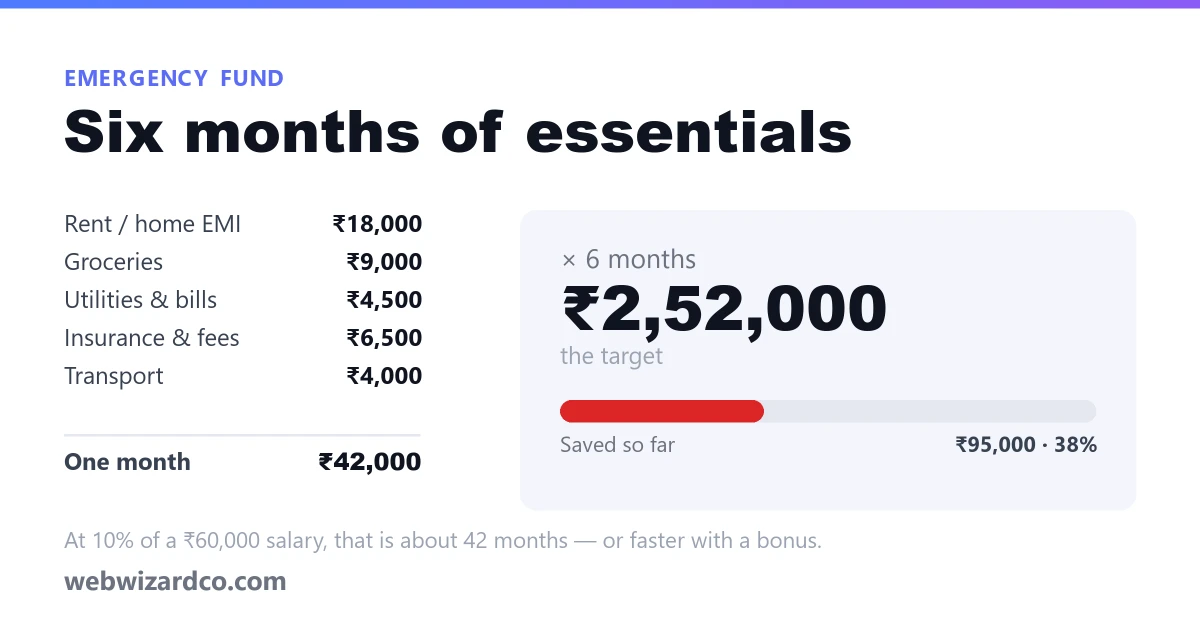
A ₹60,000 take-home, one child, renting:
| Essential | Per month |
|---|---|
| Rent | ₹18,000 |
| Groceries | ₹9,000 |
| Utilities, internet, phone | ₹4,500 |
| Insurance and school fees | ₹6,500 |
| Transport | ₹4,000 |
| One month | ₹42,000 |
| Six months | ₹2,52,000 |
Note what the target is not: six months of ₹60,000, which would be ₹3,60,000. Using expenses instead of salary cuts ₹1,08,000 off the goal — roughly a year and a half of saving at 10% of that salary.
How many months is right for you
Six is the default, not the answer. Adjust it for how quickly your income could be replaced:
- Three months — single, no dependants, no loans, in-demand skills, and family you could fall back on.
- Six months — the usual case: salaried, with a dependant or two and some EMIs.
- Nine to twelve months — single income for the family, a home loan, a senior or specialised role where the job hunt is measured in months, a medical condition in the household, or a business with lumpy revenue.
- Twelve months or more — freelancers and the self-employed, where there is no notice period, no severance, and income can halve for a quarter without warning.
Two incomes in the household can justify the lower end, but only if the household could survive on either salary alone. If it needs both, you have one income wearing two shirts — plan for the longer number.
How long it takes, and how to start
At 10% of a ₹60,000 salary — ₹6,000 a month — a ₹2,52,000 target takes about 42 months. That is a long time, and it is the point at which most people decide it is not worth starting.
It is, for two reasons. A partial fund is not useless: ₹50,000 already covers a laptop replacement, a hospital deposit or a month between jobs. And the full figure rarely comes from the monthly transfer alone — an annual bonus, a tax refund, an appraisal arrear or freelance income will get you there years earlier if you route them here first.
A sensible order: build one month of essentials as quickly as you can, then let the 10% run in the background until it is at three, then six. Once the target is reached, the 10% is released for good — redirect it to investments rather than letting it drift back into spending.
Where to keep it
Two requirements, and they are both boring: you can reach the money within a day or two, and its value does not fall when you need it.
That rules out equity — the market being down is correlated with layoffs, which is precisely the wrong time to sell. It also argues against locking the whole amount in a long fixed deposit with a penalty for breaking it. Common choices are a separate savings account (ideally at a different bank, so it is not in the account you spend from), a sweep-in or short-tenure FD, or a liquid fund with same-day or next-day redemption. Splitting across two of these is fine.
The one rule that matters more than the instrument: keep it out of your spending account. Money that shows up in your daily balance gets spent, and an emergency fund only works if you forget it exists.
General guidance, not personalised financial advice. Which instrument suits you depends on your tax situation and how quickly you might need the money.
What counts as an emergency
Job loss, a medical bill insurance does not cover, an urgent home or vehicle repair, an unplanned family obligation, a vet bill. Not: a holiday, a phone upgrade, a sale, a wedding you have known about for eight months. Those are goals, and goals get their own savings — the difference is that a goal has a date and an emergency does not.
If you do use the fund, treat rebuilding it as the next priority, ahead of resuming discretionary spending. It is the one pot that has to be refilled.
Keep the number current
Your essentials change — rent rises, an EMI ends, a child starts school. Recalculating once a year, or after any big change, keeps the target honest. If you are already logging expenses in the budget tracker, the figure is a glance at your household and travel totals rather than an evening with a calculator, and the 10% emergency-fund bucket shows how far along you are without you keeping score anywhere else.