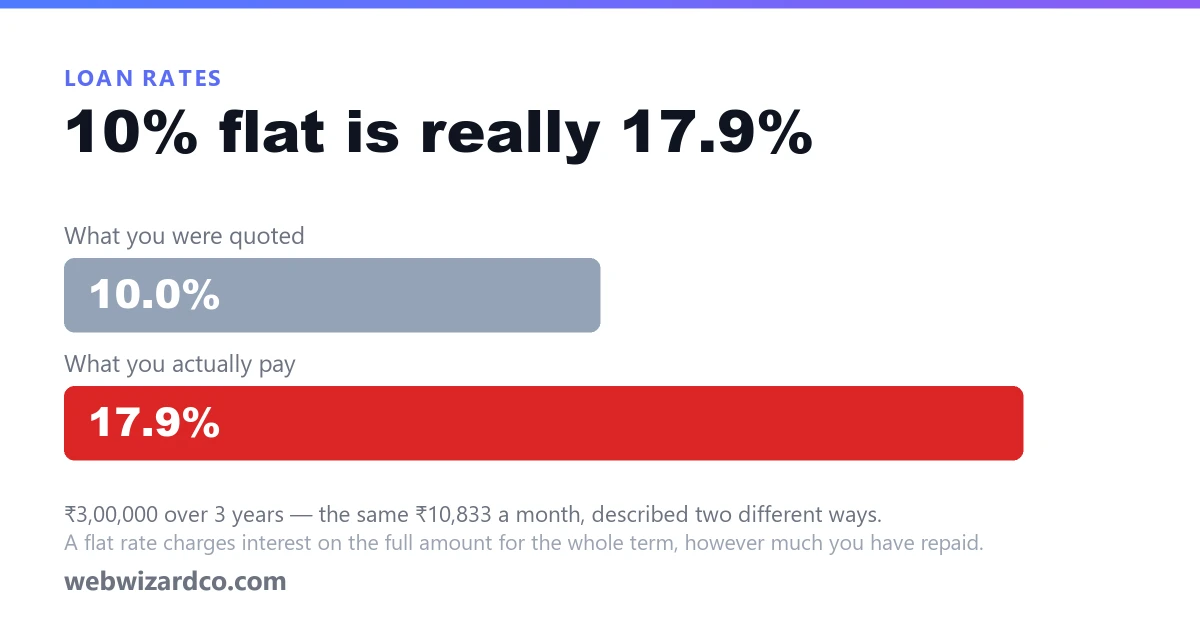
Two lenders quote you a loan. One says 10%, the other says 17%. The first is cheaper — unless the first is a flat rate and the second is reducing balance, in which case they cost almost exactly the same.
The difference in one line
Reducing balance charges interest on what you still owe. As you repay, the balance falls and so does the interest, which is why the interest portion of an EMI shrinks every month. Every bank home, car and personal loan works this way.
Flat rate charges interest on the original amount for the whole term, regardless of how much you have already repaid. In the final month, when you owe almost nothing, you are still paying interest as if you owed the entire amount.
What that does to the number
₹3,00,000 at "10% flat" for 3 years: interest is ₹3,00,000 × 10% × 3 = ₹90,000. Total repayment ₹3,90,000, EMI ₹10,833.
Now work backwards. What reducing-balance rate produces an EMI of ₹10,833 on ₹3,00,000 over 3 years? The answer is about 17.9%. Same money, same instalments, and a number nearly twice as large.
| Quoted flat rate | Term | Actually equivalent to |
|---|---|---|
| 7% | 18 months | ~12.9% reducing |
| 8% | 2 years | ~14.7% reducing |
| 10% | 3 years | ~17.9% reducing |
| 12% | 5 years | ~20.3% reducing |
The rough rule: for typical consumer tenures, a flat rate is equivalent to somewhere around 1.7 to 1.85 times the same number quoted on a reducing balance. The multiple is largest on short tenures, because the gap between the average balance and the original amount is proportionally wider.
Where you will meet it
Flat rates are common in two-wheeler finance, used-car loans, consumer-durable and no-cost EMI schemes, some gold loans, and small-ticket lending from dealers and NBFCs. They are not illegal or hidden — the word "flat" is usually right there in the paperwork. They simply rely on the fact that most people compare the number and not the basis.
How to check in thirty seconds
- Ask the question directly: "is that reducing balance or flat?" Any lender will answer.
- Get the EMI and the total repayment, not the rate. Those two are the truth regardless of how the rate is described.
- Reverse it. Put the loan amount and tenure into the EMI calculator and adjust the rate until the EMI matches the quote. That number is what you are actually paying.
Prepaying a flat-rate loan usually does nothing
This is the part that costs people real money. On a reducing-balance loan, paying early removes future interest. On a flat-rate loan the interest was fixed at the start, so clearing it early often saves little or nothing — and some agreements still charge the full contracted interest, or a foreclosure fee on top.
If you expect to repay early, the basis of the rate matters even more than the rate itself. Ask specifically what happens to the interest if you foreclose in year one.
What to compare instead
Ignore the headline rate and compare the total amount repaid across offers — it absorbs the rate, the basis and the tenure in one figure. Then add the processing fee, usually 1–3% and often deducted before the money reaches you, and any bundled insurance, which is sometimes financed into the loan so you pay interest on it too.
And if a "no-cost EMI" offer comes with a discount for paying outright, the difference between the two prices is the interest. It is not free; it is prepaid.