You have some money spare each month and a home loan running. Put it against the loan, or invest it? Ask five people and you will get five confident answers, most of them comparing the wrong things.
Here is the comparison done properly, on real numbers.
Why most versions of this comparison are wrong
The usual argument goes: "the loan costs 8.5%, equity returns 12%, so investing wins." That is the right idea and the wrong sum, because it ignores what happens after the loan ends.
If you prepay, the loan finishes years early — and from that point the entire EMI is free to invest. So the fair comparison over the same total period is:
- Prepay first: pay the EMI plus the extra until the loan clears, then invest the whole lot (EMI + extra) for the remaining months.
- Invest all along: pay just the EMI for the full term and invest the extra from month one.
Both strategies cost the same each month. Both end at the same date with no loan. The only question is which leaves you with more.
The numbers
A ₹50,00,000 loan at 8.5% over 20 years. The EMI is ₹43,391, and total interest over the full term is ₹54,13,879. You have ₹10,000 a month spare.
Prepaying ₹10,000 a month clears the loan in 12 years 11 months instead of 20 — 85 months early — and cuts the interest to ₹32,35,158, a saving of ₹21,78,721. From month 156 you then invest ₹53,391 a month (the old EMI plus the extra) for the remaining 85 months.
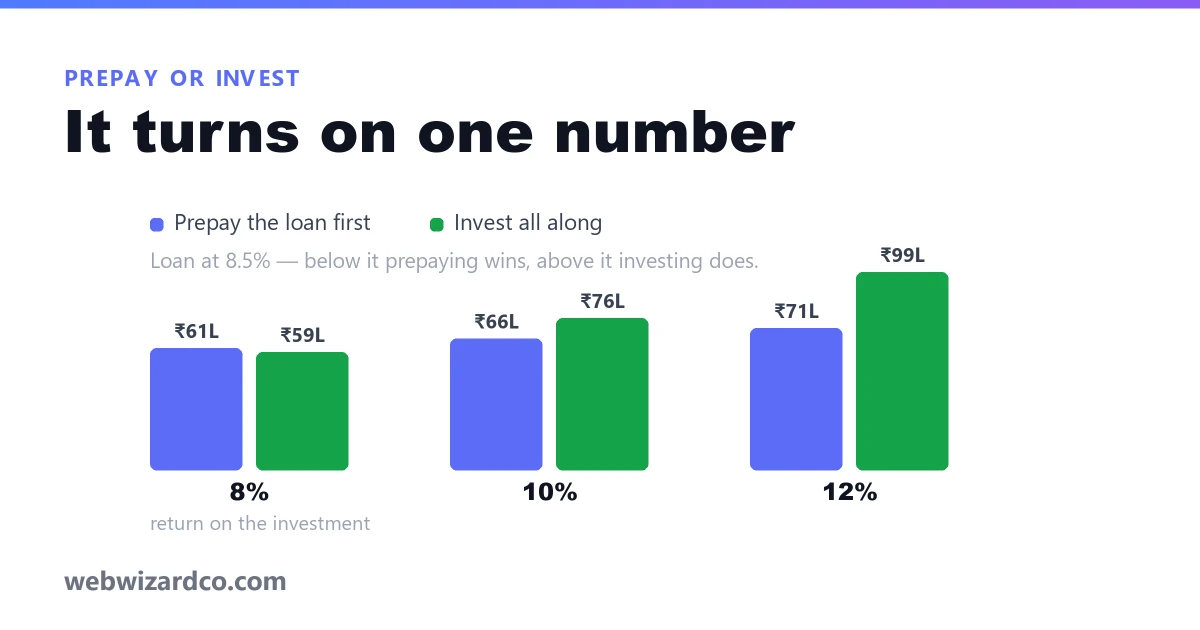
Here is where each strategy lands at the end of the 20 years:
| If investments return | Prepay first, then invest | Invest all along | Difference |
|---|---|---|---|
| 8% | ₹60,79,157 | ₹58,90,204 | Prepaying wins by ₹1,88,952 |
| 10% | ₹65,64,889 | ₹75,93,688 | Investing wins by ₹10,28,800 |
| 12% | ₹70,99,903 | ₹98,92,554 | Investing wins by ₹27,92,651 |
The crossover is your loan rate
Look at where it flips: somewhere just above 8%, which is the loan's own interest rate. That is not a coincidence, it is the whole answer. Prepaying a loan is mathematically identical to an investment that returns the loan's interest rate, guaranteed, tax-free and with no volatility.
So the question is never "prepay or invest". It is: can I reliably earn more than my loan rate, after tax, over this period? At 8.5% that is a genuine question. At a 14% personal loan it is not — nothing dependable beats that, which is why expensive debt should always be cleared before investing a rupee.
What the arithmetic leaves out
The 12% is not promised. The prepayment return is certain; the equity return is an average across decades that includes years of −30%. If your 20 years happen to end in a bad one, the invest-all-along column can look very different. Prepaying has no sequence risk at all.
Tax moves both sides. Under the old regime, deductions on home loan interest and principal lower the effective cost of the loan, which pushes the crossover down in favour of investing. Under the new regime most of that is gone, which pushes it back up. Equity gains are taxed on the other side. Rules change, so check where you actually stand before treating either column as final.
A cleared loan changes what you can do. No EMI means a job you can leave, a business you could try, a bad year you can absorb. That is worth something the spreadsheet cannot price, and for many people it is the deciding factor.
What to actually do
- Clear expensive debt first. Credit cards at 30–45% and personal loans at 14% are not close calls.
- Finish the emergency fund before either. Prepaying is irreversible — that money is in the walls. An unexpected month with no buffer and no liquidity is how people end up borrowing expensively against a house they have been busy prepaying. Work out your number first.
- Keep the monthly SIP, prepay with the lumps. A bonus, an arrear or a tax refund is money your budget never learned to depend on, and it is the least painful prepayment you will ever make.
- Prepay early in the loan. The same ₹1 lakh paid in year two removes far more interest than in year fifteen, because it stops interest on that balance for every remaining month.
- Do both. For most people the split that actually gets followed beats the optimal one that does not. Consistency is worth more than a percentage point.
Run your own figures in the home loan calculator — put your spare amount in the extra-payment box and see what it does to your term.
General information, not personalised financial advice. Your tax position, job security and other debts all change this calculation.