There are two answers to this, and they are far apart. The lender's answer is how much they will approve. The useful answer is how much you can carry for twenty years without the rest of your life going on hold.
The comfortable number
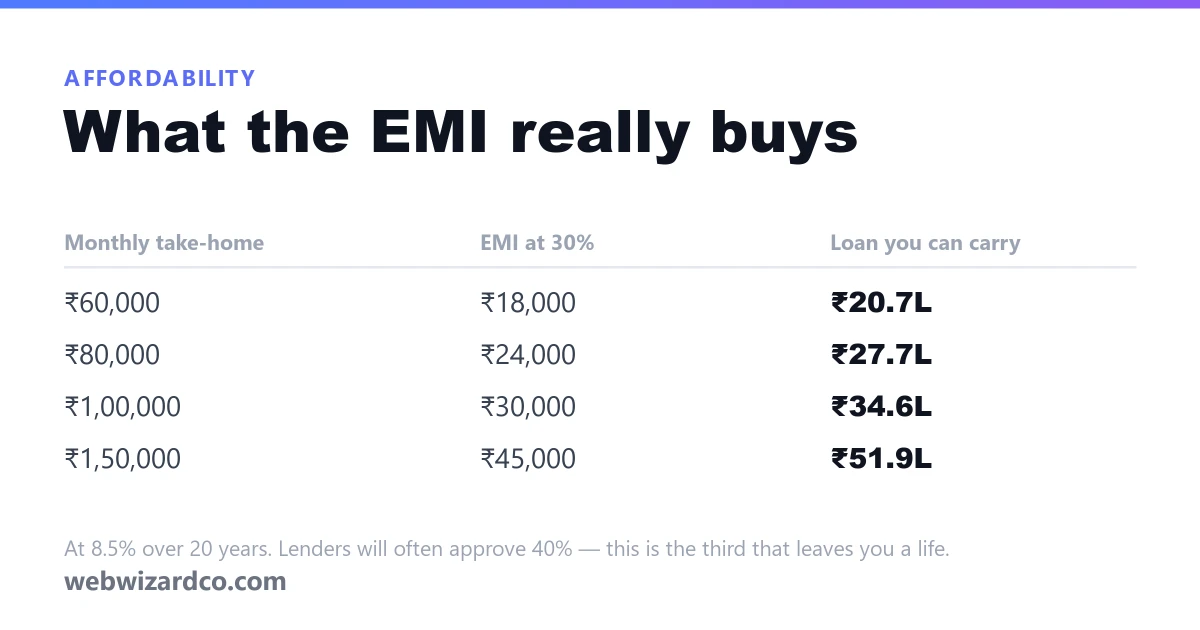
Keep the EMI near 30% of take-home pay and you keep a life. At 8.5% over 20 years, that works out as:
| Monthly take-home | EMI at 30% | Loan it supports |
|---|---|---|
| ₹60,000 | ₹18,000 | ₹20,74,155 |
| ₹80,000 | ₹24,000 | ₹27,65,540 |
| ₹1,00,000 | ₹30,000 | ₹34,56,925 |
| ₹1,50,000 | ₹45,000 | ₹51,85,388 |
Lenders will usually go to 40% of income across all your EMIs, and sometimes past it. On ₹60,000 that is ₹24,000 a month and a loan of ₹27,65,540 — about 33% more house. It is also the point at which a single bad month has nowhere to come from.
The loan is not the price of the house
Lenders finance around 80% of the property value, so an ₹18,000 EMI supporting a ₹20,74,155 loan corresponds to a property of roughly ₹25,92,694 — and you need about ₹5,18,539 of down payment before any of it happens.
On top of that come registration and stamp duty, which vary by state and typically run to several percent of the value, plus legal and processing fees. Budgeting around 7% of the property value for these adds roughly ₹1,81,489 to the cash you need on the day. None of it can be borrowed on the home loan.
Stretching the tenure buys less than you think
The usual way to afford more is a longer loan. It works far less well than it feels. The same ₹18,000 EMI at 8.5% supports:
- 15 years — ₹18,27,894
- 20 years — ₹20,74,155
- 25 years — ₹22,35,394
- 30 years — ₹23,40,966
Going from 20 years to 30 — half as long again in debt — buys about 13% more house, and adds lakhs in interest for the privilege. The curve flattens because at these rates the later years of a long loan are almost entirely interest; they barely lend you more.
If the house you want needs a 30-year tenure to be affordable, the honest reading is usually that it needs a bigger down payment or a smaller house, not a longer loan.
What else has to fit in the same bucket
On the 25-10-15-15-35 budget, housing comes out of the 35% household share — which also has to cover groceries, electricity, water, gas, internet, help, society maintenance, school fees and repairs. An EMI at 30% of take-home leaves 5% for all of that, which does not work.
In practice a home EMI around 30% of income means the household bucket has to expand, and something else — usually lifestyle, sometimes investments — has to shrink. That is a legitimate choice, but it should be a choice made in advance rather than discovered in month three.
And owning costs more than renting the same place: maintenance, property tax, society charges and repairs land on you, not a landlord. A reasonable planning figure is a few thousand a month set aside for the house itself.
Before you apply
- Track two real months of spending, so the 'what is left over' number is measured rather than guessed. The expense tracker does this in about ten seconds a day.
- Keep the emergency fund intact. Do not empty it into the down payment — a new house is precisely when unexpected costs arrive.
- Add the other EMIs. Lenders count them; so should you. Car, gadget and personal loan EMIs come out of the same income.
- Test the EMI for three months first. Move the difference between your rent and the proposed EMI into savings each month. If it is painless, the loan is affordable. If it is not, you have learned that for free.
Put your own salary into the home loan calculator — it shows the EMI as a share of your take-home pay as you change the amount.
General information, not personalised financial advice.