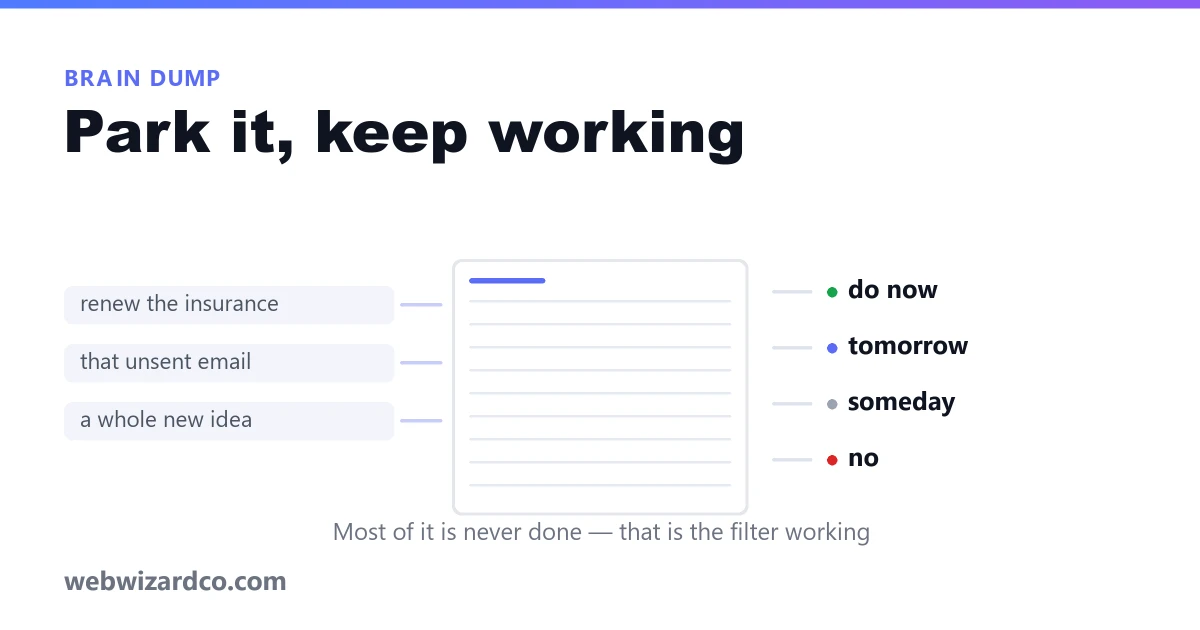
You are halfway through something and a thought arrives. Renew the insurance. That email you did not send. An idea for an entirely different project, which is immediately more interesting than the thing in front of you.
You have three options. Act on it, and lose the thread of what you were doing. Hold on to it, which costs attention continuously for as long as you hold it. Or write it down and keep working. The third is the brain dump, and it is the cheapest of the three by a wide margin.
What it is, and what it is not
A brain dump is a single place where thoughts go so you can stop carrying them. It is not a to-do list, not a project plan, and not a commitment. Nothing in it is promised. That distinction matters: the moment the box becomes a list of obligations, writing in it starts to feel like adding to your problems, and you stop using it.
Why writing it down works
An unfinished thought keeps asking for attention. Writing it somewhere you trust is enough to stop the asking — not because you have dealt with it, but because you no longer have to keep it in mind to avoid losing it.
The "somewhere you trust" is the whole trick. A note you will never find again does not stop the asking, because some part of you knows it is lost. One box, in one place you will see today, is better than five apps you might check.
Three moments worth using it
At the start of the day. Before planning, empty out whatever is already in your head. A lot of it turns out to be two minutes of work or nothing at all, and both are easier to see on paper than in your head at seven in the morning.
Mid-task, the moment a thought arrives. Write four words and carry on. The whole point is that it takes less time than deciding whether it is important — deciding is what breaks concentration, not writing.
At the end of the day. Whatever is still circling goes on the page so it is not circling at eleven at night. This one is less about planning and more about being able to stop.
What to do with it afterwards
Sort it once a day, briefly:
- Two minutes or less — do it now, at the sorting, not when it arrived.
- Actually matters — it becomes one of tomorrow's three priorities. Most days that is one item, occasionally two.
- Someday — a separate list you check weekly and are allowed to ignore.
- No — cross it out. This is the most important category and the least used.
Most of what you capture is never going to be done, and that is the system working rather than failing. A brain dump is a filter, not a backlog. If it is turning into a growing list of things you feel guilty about, you are not crossing enough out.
Paper or phone
Phones capture well and are always with you. They also open onto everything else, which is a real cost when you are already mid-task and a notification is one glance away.
Paper has no second screen. A box on the page you already have open takes a few seconds and returns you to exactly where you were. The honest answer is to use whichever you will actually reach for — and if that is the phone, one note, not five apps.
The planner generator gives the brain dump a deliberately oversized box, because a small one quietly teaches you to only write down the important ones, and sorting out what was important is the job you were trying to postpone. It pairs with time blocking: blocks for what you decided to do, the box for everything that turns up while you are doing it.