Time blocking means deciding in advance what happens when, instead of working from a list and choosing each time you finish something. The choosing is the expensive part, so removing it helps — which is why the technique gets recommended so often. It is also why it fails so often, because most advice stops before the parts that actually matter.
Why a list is not enough
A to-do list tells you what. It says nothing about how long, and a list of six items can be anything between two hours and two days. If duration is not something you feel reliably — and for a lot of people with ADHD it is not — a list quietly lets you plan a fourteen-hour day and not notice until the evening.
A block has a size. An hour-tall box on the page is an hour, visibly, and three of them fill a morning you can see. That is the actual mechanism: it is not that blocking makes you more disciplined, it is that it makes the arithmetic visible before you commit to it.
Block the day you have
Start the grid when your day really starts. If the first useful hour is ten, a plan beginning at seven is three rows of fiction at the top of every page. Ending it honestly matters too — if nothing real happens after six, do not leave four evening rows waiting to be disappointing.
Pick a block size that matches how you switch
One-hour blocks mean less to fill in and less to maintain, and they suit work that comes in big pieces. Thirty-minute blocks suit a day of small, varied things, and make the page a more honest picture when nothing lasts an hour.
Finer is not better. Thirty-minute blocks across a twelve-hour day is twenty-four decisions, and the planning itself becomes the task you are avoiding. If you cannot fill the page in about three minutes, the blocks are too small.
The buffers are the technique
This is the part that gets left out, and it is the part that decides whether the day survives.
Blocks rarely overrun because the work took longer than expected. They overrun because of everything between: finding the document, the walk to the other room, the conversation on the way, the tab you opened for one thing. None of it is in the plan, all of it is real, and it adds up to far more than people estimate.
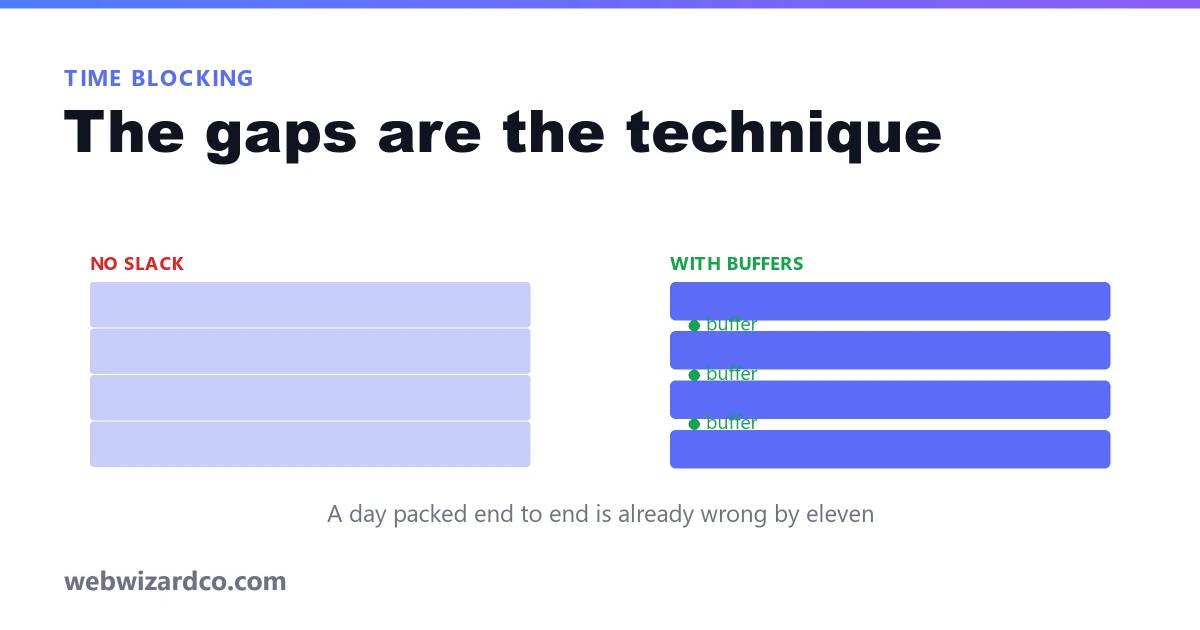
So put the gap in on purpose. Ten minutes between blocks, or one empty block every few hours. A day packed end to end with no slack is not an ambitious plan, it is one that is already wrong — and once the plan is wrong by eleven, the page stops describing your day and you stop looking at it.
Three things, not twelve
Blocking the whole day does not mean everything in it is important. Pick three that matter and block those first, in the hours you are actually any good. Everything else fills in around them. If the day falls apart, you know which three to defend.
When it breaks by ten in the morning
It will, regularly. The useful response is not to abandon the page or to start the day again tomorrow. It is to re-block what is left. Cross out the rest, look at the remaining hours, and put the big three somewhere they still fit.
A plan is not a promise you broke. It is a guess about a day that had not happened yet, and guesses get revised. People who make time blocking work are not the ones whose plans survive — they are the ones who rewrite the afternoon without treating it as a failure.
Paper or app
An app can remind you. Paper cannot, and no amount of enthusiasm changes that — if you need something to interrupt you at 2pm, set an alarm. What paper does better is show the whole day at once, with nothing collapsed, hidden behind a tab or scrolled off. For the deciding-and-seeing part, a page is hard to beat.
Both is the normal answer: alarms for the interrupting, a printed page for the thinking. And if your planner keeps getting abandoned after a few days, that is usually a design problem rather than a discipline one.